
Fill in the form to see the minimum ramp length you need.
Need help measuring?
Portable Wheelchair Ramps


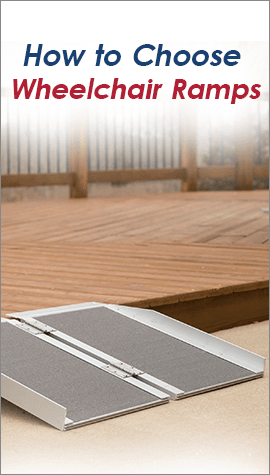


Designed to be lightweight, compact, and easy to carry, these ramps are perfect for ensuring that you always have a wheelchair accessible entrance. They are available in a variety of sizes, weight capacities up to 800 lbs. for full size scooters and bariatric applications, and styles including single fold, multi-fold, Roll-A-Ramps, and single piece, seamless ramps. They are designed with high-traction surfaces to reduce the risk of slips and falls in all weather conditions, and all come with convenient carrying handles to facilitate repositioning and transporting the ramps from one location to another.
Advantages of a Portable Wheelchair Ramp
The great thing about a portable wheelchair ramp is that they are constructed with portability in mind. They're often built to be folded in half or quarters, or to break down into two pieces to further reduce the carrying weight. Since the ramps can be at large as 12' long, the ability to reduce them to smaller sizes makes it easier for every user to transport them. Even if they are placed in a location where they won't be moved, having the ability to carry them to that location upon arrival will be appreciated. Most also have carrying handles so that you're not struggling to hold or carry the bare aluminum.
How to Choose the Right Wheelchair Ramp Length
To ensure that you order the correct size ramp, it is important to take a few key measurements as outlined below. The length of the ramp will depend on the total height you're trying to overcome. ADA Regulations requires that for every inch you're going up, you should have at least 12" of ramp to create a nice, gentle slope (1:12 ratio). However, for personal residences the slope can be steeper if needed, especially if you're using the ramp to wheel your loved one's empty chair or scooter up into the house. In those cases, for every inch of rise, only 6" of ramp is recommended (1:6 ratio).
Measurements to take when identifying the correct ramp length:
- The rise, or height of the step you want to surmount.
- The amount of space in front of the rise, as this might limit your ramp length.
- The amount of space in front of the entryway, as this might limit your ability to turn.
For example, if you have a 6" step going up to your front door, you will need at least a 6' long ramp to meet ADA compliance, or a 3' long ramp since the ramp is being used at your residence.
Here's a quick guide to calculate the rise to run ratio:
- 1" rise = 1' ramp (ADA) or 6" ramp (residence)
- 2" rise = 2' ramp (ADA) or 1' ramp (residence)
- 3" rise = 3' ramp (ADA) or 1.5' ramp (residence)
- 4" rise = 4' ramp (ADA) or 2' ramp (residence)
- 5" rise = 5' ramp (ADA) or 2.5' ramp (residence)
- 6" rise = 6' ramp (ADA) or 3' ramp (residence)
- 7" rise = 7' ramp (ADA) or 3.5' ramp (residence)
- 8" rise = 8' ramp (ADA) or 4' ramp (residence)
- 9" rise = 9' ramp (ADA) or 4.5' ramp (residence)
- 10" rise = 10' ramp (ADA) or 5' ramp (residence)
- 11" rise = 11' ramp (ADA) or 5.5' ramp (residence)
- 12" rise = 12' ramp (ADA) or 6' ramp (residence)
Choosing a ramp that is too short can be dangerous, as the steeper slope means the person in the chair or scooter risks tipping backwards as they go up.
For detailed information about this topic, please read How to Determine Proper Wheelchair Ramp Length.
Portable Ramps vs. Threshold Ramps
How do you decide which one you need? Here are a few comparisons that will help you identify the ramp that's the best fit for you.
- Threshold ramps are typically used for more permanent solutions.
- Portable ramps are perfect for temporary situations such as vacations and travel.
- Both are designed to allow easy access over obstacles, or into hard-to-reach rooms and buildings
- Threshold ramps will only work for the rise it has been designed for, and is meant for bridging an small entryway into rooms and buildings.
- Portable ramps are versatile; they can accommodate a variety of rises and are specifically designed to go over stairs.
Aluminum Ramps Help With Portability
The lightweight aluminum construction of our portable wheelchair ramps keep the weight down so that transporting them is less of a strain of our customers. We understand that many of the individuals using our ramps have limited mobility and by offering portable ramps our goal is to increase the accessibility for their loved ones in a way that's as easy as possible. Although steel ramps are not very common, occasionally DIY wooden ramps are used to bridge steps. Those are not only less portable than aluminum ramps, they often become slick and slippery in inclement weather, and are not a safe choice.
Portable Wheelchair Ramp Maintenance
Aluminum is, by nature, a low-maintenance material as it will not rust like steel, or rot like wood. Maintaining a wheelchair ramp, whether for your home or your business is simple, clean it with soap and water if it gets dirty and inspect the ramp regularly to ensure that any screws or rivets are secure. For ramps with a grit coat, use a broom or brush to remove debris.
Portable Ramps on a Budget
Save up to 50% when you shop our clearance center and open box specials! Find inexpensive wheelchair ramps, and receive free same-day shipping.
For more details on types of ramps and finding the best option for your specific needs, please read How to Choose a Wheelchair Ramp