
How to Determine Proper Wheelchair Ramp Length
Updated on: March 24th, 2025
When the time comes to upgrade your home for easier access, choosing the proper ramp length can seem like a daunting task. A ramp that is too short results in a steep grade that will not only take more effort to safely navigate, it could lead to injury if a fall occurs. Ramps that are too long for the step or steps will decrease the steepness of the slope, making it safer and easier to use than shorter ramps, however if the ramp is longer than necessary it may require additional space that isn't feasible at your location.
To choose the safest ramp length for your space and vertical rise, we've put together comprehensive guide to understanding the required calculations and created a mobility ramp calculator to make it as easy as possible to determine the ramp length that is right for your home.

Understanding the Important Measurements
- Vertical Rise: The total height that you want to overcome. If it includes more than one step, add the height of each step to determine the total vertical rise in inches.
- Available Distance: How much room you have to work with. Start your measurement at the top of the highest step, where the top of the ramp will be placed, then extend straight out as far as you can until you hit an obstacle. This is an important measurement for entryways with turns or other obstructions as it could be a limiting factor on how long your ramp can be.
- Total Usable Width: Measure the width of your entryway, specifically the area where you will need access with a wheelchair, mobility scooter or other mobility device. 30” or 36” is typical to ensure safe passage, however in older buildings it could be less.
- Ramp Length: Threshold ramp lengths are typically measured in inches, as they are shorter, and the length for wheelchair ramps or modular ramps are typically measured in feet. ADA requirements are specific about the slope of the ramp in different use scenarios, and that will drive the ramp length you need.

ADA Requirements for Handicap Ramps
Knowing the ADA Requirements will help you understand the figures that the Mobility Ramp Calculator outputs.
The Commercial Occupied Useratio of 1:12 is the most commonly recommended slope for wheelchair ramps, however in private residences the slope can be smaller to accommodate for older construction and tighter spaces.
The 1:12 slope ratio means that every one inch of vertical rise requires at least one foot (12") of ramp length. This creates an incline of about 5 degrees.
For example:
If you have a 1.5" lip, you'll need a threshold ramp that's at least 1.5' long.
If you're overcoming a single step, which is generally about a 7" rise, the ramp should be at least 7' long to be considered ADA compliant. A portable wheelchair ramp will be your best choice.
If you're overcoming three 7" steps (7" x 3 = 21"), your ramp would need to be at least 21' long to be considered ADA compliant. Modular ramp systems are perfect for that scenario.
Supplementary ADA Resources:
ADA Specifications for Wheelchair Threshold Ramps and Landings
Calculate the Ramp Length You Need
Our mobility ramp calculator uses the vertical rise, or rise, to calculate the minimum ramp length you need. Fill in the form to see the minimum ramp length you need for commercial access or residential access so that you can start your ramp search by narrowing down length options.
Input the loading height, or rise, in inches below to find your minimum ramp length
Finding the appropriate wheelchair ramp

Threshold Ramps / Door Entry Ramps
Typically available in lengths up to 2', threshold ramps are perfect for maneuvering wheelchairs, powerchairs, and mobility scooters over short rises around the home or office, uneven surfaces, or through doorways where the bottom plate creates a challenging barrier.

Portable Wheelchair Ramps
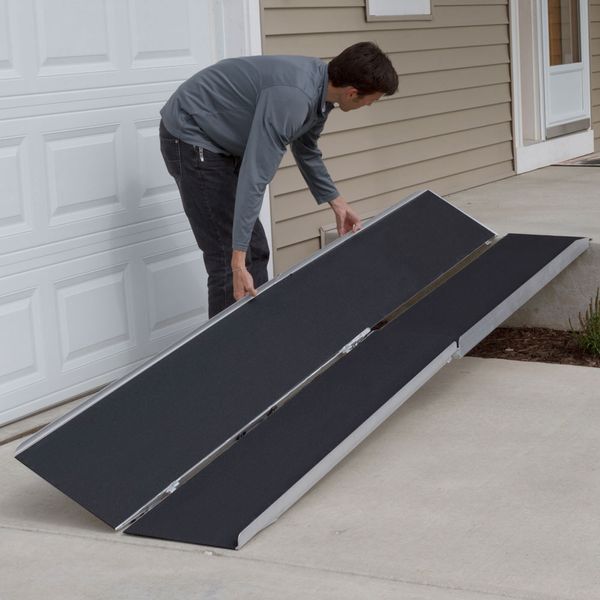
For larger rises or multiple steps, portable wheelchair ramps are available in sizes starting at 2' all the way up to 12'. Some of the features to consider are whether you want a ramp that folds for easier portability, or one with mounting holes to permanently secure it to the top step.

Modular Wheelchair Ramps
Available in large sizes up to 30', and multiple configurations with L-turns and U-turns, these modular ramp systems typically require more intense installation and the use of platforms to break up the long ramp lengths for ADA compliance.
- Wheelchair Ramp Calculator
- How to Choose the Correct Wheelchair Ramp
- How to Choose between Full-Width Portable Wheelchair Ramps and Track Ramps