
Trikes: Loading, Transport, Storage and Service
Posted on: May 19th, 2025

What is a Trike?
A trike, or 3 wheel motorcycle, is exactly what it sounds like - a stable way to enjoy the breeze of a motorcycle ride without the worry about supporting its weight when it's stationary. The reduced tip-over concern is great for riders who either don't want the hassle of a tip hazard, or who are longer able to lift the weight of a motorcycle like they used to and still want the freedom that comes with riding.
Trikes are street legal, and no harder to ride than anything else on the road. They do not tip over easily, and in that respect they could be considered safer than motorcycles... keeping in mind that no vehicle is ever 100% safe.
Because of the three-wheel design, trikes fall into two categories: vehicles with two front wheels and one rear wheel (think Can Am), and vehicles with two rear wheels and one front wheel.
Trike vs Motorcycle: How do They Compare?
- More Comfort: Because trikes are built larger, you'll enjoy a wider seat while you ride.
- More Stability: No need to balance 400+ lbs. of motorcycle, you'll be able to jump onto your trike and go. Less core strength required when coming to a stop or starting a ride.
- More Storage: Trikes have more room for luggage, snacks and gear as there's simply more room overall.
- Less Steering: It's a bit harder to steer a trike due to the layout of their wheels, and the fact that you can't counter steer. On one hand, you don't have gyroscopic force on the front wheel, however you will have to be heavy-handed with your hands when you turn.
- More Power: With more frame comes more space for horsepower.
- Larger Width: The wider wheelbase means that you won't be able to slip your trike into a partial garage space - you will probably need the same amount of room as a gold cart or UTV.
- Navigating Traffic: While motorcycles can weave, trikes are limited to a lane much like a car. This means that if traffic is heavy, or worse, at a standstill, there will be no way to get around it. You're stuck with the cars, rain or shine.
- Better Visibility: Drivers in cars will be able to see you with greater ease because you physically take up more space on a trike than a motorcycle.
- Comparable Price: Much like motorcycles, trikes get expensive quickly. Brands like Can Am can start at $10,000, and Harley-Davidson starts their three-wheelers at $30,000 and goes from there. Unlike motorcycles, it is harder to find bare bones or entry-level trikes.
Loading, transporting and storing a trike
Because trikes have a larger footprint than a motorcycle, additional consideration is needed when it comes to transporting, storing, and maintaining them.
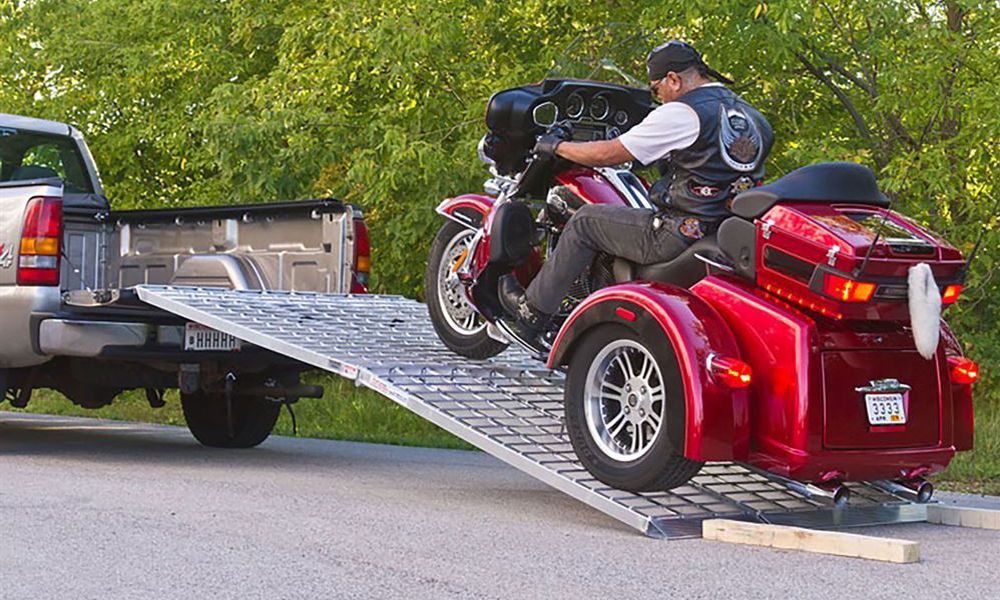
Loading a trike on a trailer or truck
If you plan on transporting your trike by truckbed or trailer this year, think carefully about the the ramps you'll need to ensure a safe loading and unloading process. Reference How to Choose a Motorcycle Ramp for more detailed information, as well as a loading ramp calculator, and be aware that the biggest difference between a motorcycle ramp and a trike ramp will be the required width. You will need a full-width motorcycle ramp to accommodate the dual wheels on the front or back, and having the right length (or longer than you need) will ensure you won't scrape your tailpipe or high-center at the top of the ramp while loading. For situations where the ramp length is adequate but you have a longer tailpipe, wooden planks under the ramp or adjacent to the ramp will assist in creating the additional clearance.
Average width of popular trike models
| 2025 Model | Overall Width |
| Can-Am Spyder F3 | 58.9" |
| Harley-Davidson Tri Glide Ultra | 54.7" |
| Polaris Slingshot | 77.9" |
| Yamaha Tricity 300 | 32.1" |
| Piaggio MP3 500 | 31.5" |
| Vanderhall Venice | 68.9" |
| Can Am Ryker | 59.9" |
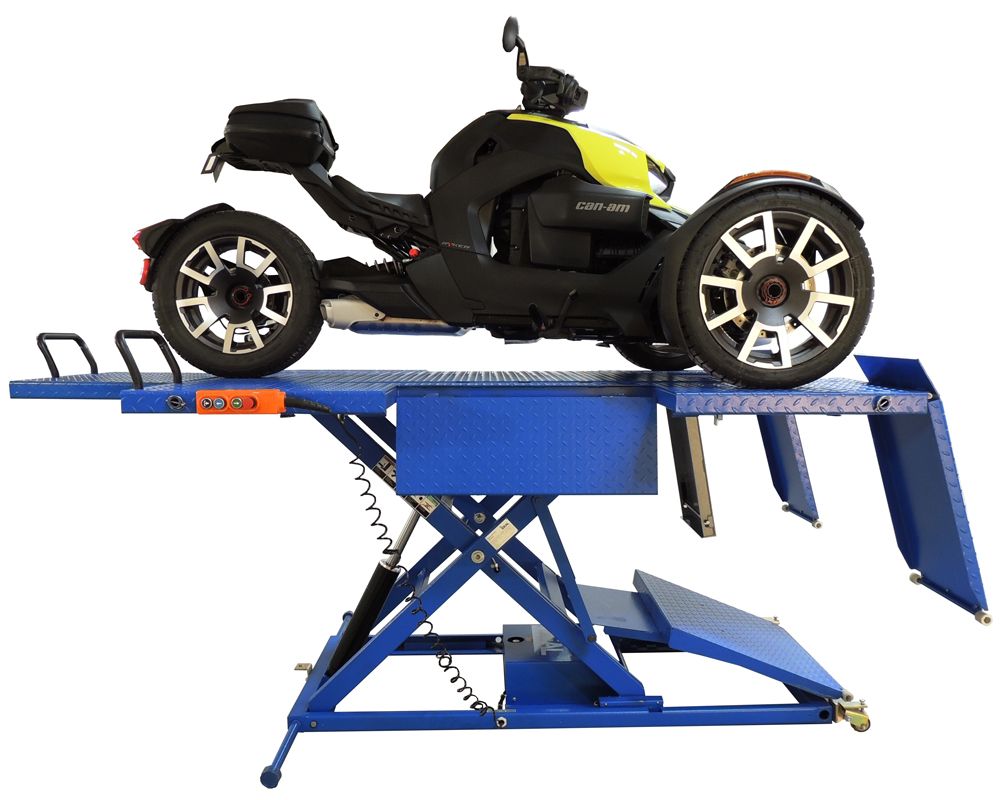
Working on a trike in your garage
For trike enthusiasts who enjoy doing their own maintenance, having the right equipment is essential, and one of the most valuable tools you can invest in is a lift table. This handy device elevates your trike to a comfortable working height, eliminating the need to bend or crouch, so you can work on your vehicle more efficiently. With a lift table, tasks such as changing the oil, checking the brakes, or replacing tires become more accessible and less physically demanding. The added stability provided by a lift table ensures that your trike remains secure while you perform maintenance, reducing the risk of accidents. Therefore, if you have a garage and plan to perform regular maintenance, a lift table is a wise investment, enhancing both convenience and safety during your trike upkeep.
Because trikes have such a wide wheelbase, it means that any lift table purchase can also be used with most golf carts, ATVs, UTVs and maybe even a motorcycle (if your lift table model has a mounted wheel chock accessory). You'll be able to work on a multitude of toys and equiment, not just your three-wheeler, making it a smart investment if you already have several other powered vehicles on your property.

Storing a trike
If, like me, you live in a state where the riding season is maybe 5 months out of the year, having a game plan for trike storage is a must. If you have the garage space, invest in a proper trike storage cover and follow the steps for winterizing a motorcycle at the end of the season, and prepping your trike for the riding season.
Disclaimer: This educational article contains general information only; Discount Ramps cannot be held liable for damage, injuries, or accidents that occur after reading this article.