Modular Ramps Create Custom Access for Your Home
Updated on: May 30th, 2025

Whether the need for a wheelchair ramp is a sudden necessity or something you've been building towards for a while, it can feel overwhelming to know where to start shopping for a ramp that allows you or your loved one easier access into your, or their, home.
For doorways with a threshold, lip, or small step, a portable ramp or threshold ramp can often be the solution, however if the entrance has one or more steps over 12" high, then a complete system that includes ramps, handrails, and possibly a platform will be the safest and easiest option for navigating in and out of the home.
The high cost of a modular system can often be daunting, which regularly prompts people to DIY wooden or metal ramps. While skilled individuals find that workaround is successful, those homemade ramp can be unsafe, slippery, and require a lot of maintenance.
Because modular ramps are engineered and manufactured by professionals, they are built to strict safety guidelines and many are designed to follow ADA standards when installed. They can make entryways as high as 3' above the ground easily accessible to anyone in a wheelchair or scooter, as well as individuals with limited mobility who may or may not use a walker or rollator.
Where to Begin: Look at the Entryway
Because every house and every entryway are different, assessing both is a great place to start. The total height you're trying to overcome will be the primary factor for determining the length of the ramp you need, but where your doorway is situated could impact the style of ramp and how it gets installed.
Here are a list of entryway questions that will help you identify any potential factors that will impact the type of ramp that works for your specific application:
- What is the overall height to overcome? This will directly impact the length of the ramp needed. It might include the height of a porch, a threshold, or both.
- Is the ground level before the start of the first step, or does it slope up/down? If it slopes down, a shorter ramp might be needed. If it slopes up, a longer ramp might be needed.
- Does the door open inward or outward?The ramp handrails must not impact the ability of the door to swing freely.
- How much distance is there in a straight line away from the door? This will impact how long the ramp can be before a turning platform is required. This is common in locations where a city sidewalk is close to the entry door, or with mobile/manufactured homes where it's better to run the ramp parallel to the home.
- Will the ramp connect to the door threshold or to a step/porch? In some cases, the larger ramp will connect to the porch, and a threshold ramp can clear the door's threshold.
Next: Calculating the Ramp Length You Need
Although this might feel more like an art rather than a science, there's a simple way to assess how much ramp you think you will need. Measure the vertical distance from the ground up to the top of the highest step in inches. That measurement is called the rise.
ADA regulations state that for every 1" of rise, you should have 12" (or 1') of ramp so that the slope is gentle enough to go up and down. Unfortunately, this means that if your rise is 13", you'll need at least a 13' ramp to meet that 1:12 ratio. That's why knowing if you have enough space to accommodate the ramp length you need is so important. You might need a 13' ramp, yet the city sidewalk cuts through the space you need for your ramp.


Conveniences of Any Modular Ramp System
- Custom layout: You get to piece together the exact ramp length and platforms you need, with nothing you don't. Because the ramp is modular, it will conform to your space instead of you having to alter your space to accommodate your ramp.
- Simple installation: Most modular ramp lines are designed to be installed as easily as possible, with few tools and hardware. This adds to the appeal of modular systems over bulkier alternatives as well as DIY wooden ramps.
- Repair options: Unlike a complex system or solid wood ramp, the piece-by-piece design of modular systems make them much easier to swap out and replace in the event of damage.
- Take it with you: If you move, or decide that a different layout would be better, removing the ramp should be as simple as the installation. Reconfiguring it will be just as easy as the initial setup, and if you need additional pieces it will be easy to order exactly what you require.
Examples of Installed Modular Handicap Ramps:

Example #1: This individual had a porch step and a threshold with a storm door that opened outwards. The ramp could not be placed directly on the door's threshold because of the outward opening storm door. Instead, a self-supporting platform allows the storm door to swing open fully, and the 10' ramp allowed the individual to safely access their home.
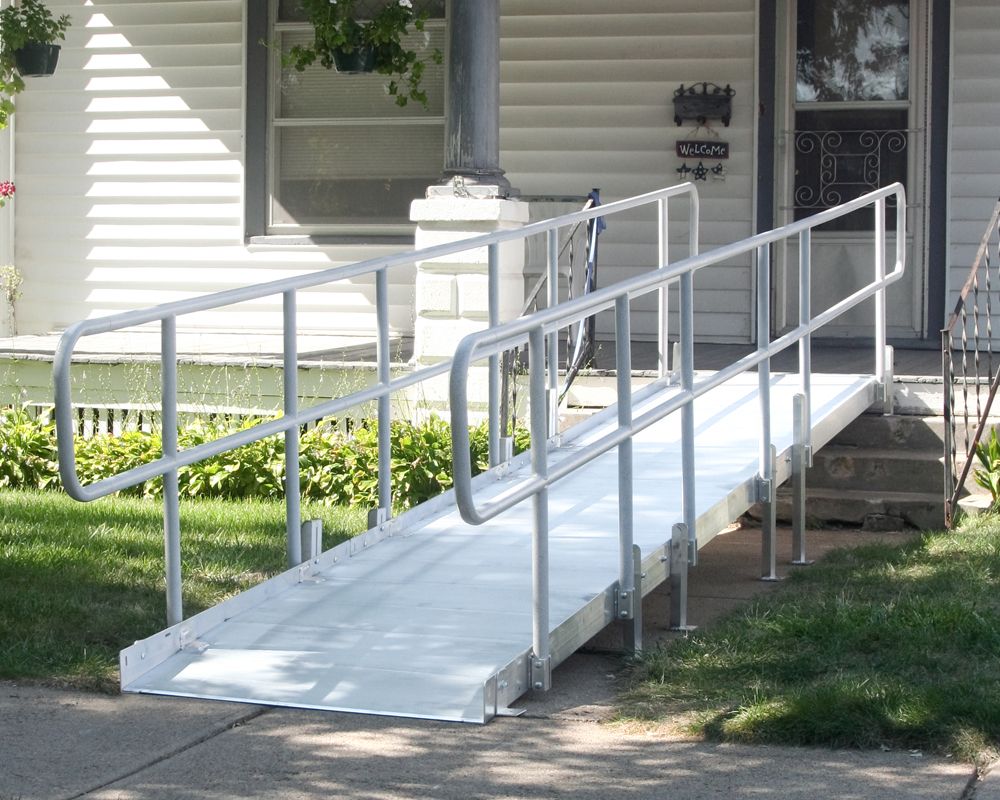
Example #2: This customer has a full porch and no threshold, therefore their storm door could swing open fully with no issue. They had enough room between their steps and the city sidewalk to install a straight ramp with double handrails.
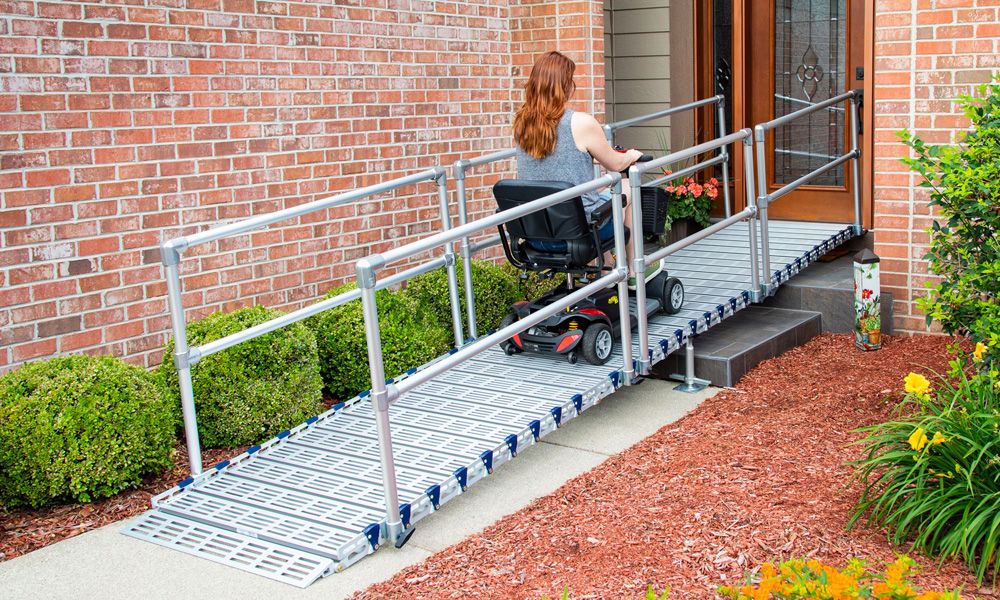
Example #3: With plenty of room and no city sidewalk, this customer was able to install a straight ramp with double handrails right up to their door.
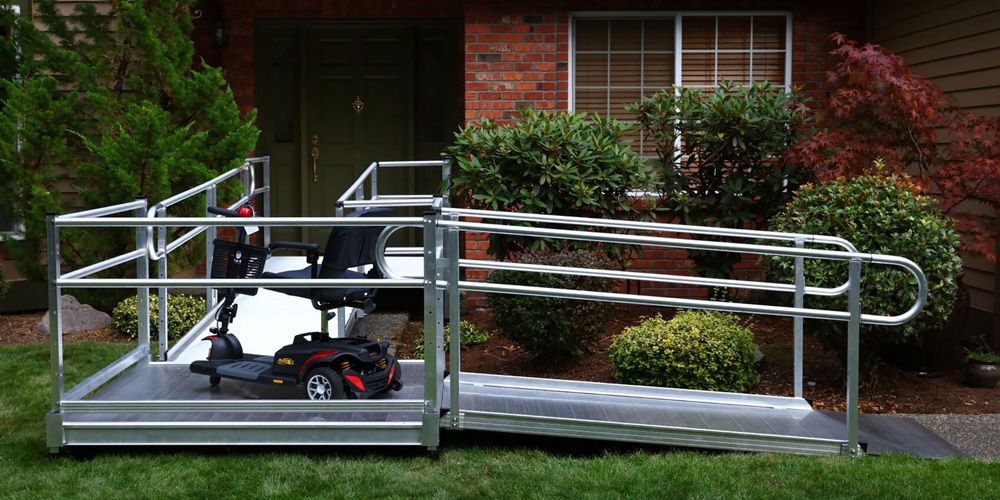
Example #4: This customer had a 90-degree turn in their pavement. A straight ramp would have sent their scooter out onto the lawn. Instead, they chose to install a turning platform. Not only did that ensure their scooter ended up on the pavement, it also created a break in the long ramp for other users.
ADA compliance and step-by-step buying guidance
Depending on where you purchase your modular ramp, you should expect a simple overview of how to make sure your ramp is ADA compliant (and therefore as safe as possible). If you have questions or would like assistance, experienced team members will guide you through the selection process and help you choose the best modular ramp set up for your unique situation and location.
For assistance in purchasing Discount Ramps modular ramp systems, please call (888) 651-3431.

How to order a modular ramp system
We always recommend reaching out to our experienced customer care team for help in determining the ramp that's right for your situation. They help thousands of people every year, and not only do they understand the limiting factors that can impact the placement of a ramp, they will help you navigate to a solution with care, compassion and sensitivity.
If you plan on purchasing a modular ramp system without engaging the assistance of a team member, we encourage you to jot down some of the factors that will be important to your decision-making process as you start to shop:
How high is the total height you are trying to overcome?
Calculate the ramp length you need to safely overcome that rise; taking into account the ADA 1:12 guideline. If you need help, use our Wheelchair Ramp Calculator to assist you.
For longer ramp lengths and special configurations, use our Modular Ramps Calculator to view all of the options that will work with your specific rise.


If you measure straight out from the top of the highest step as far back as you can, do you have enough room to accommodate a ramp of that size?
Knowing how much space you have to work with will help you determine if a straight ramp, L-shape or U-shape makes more sense for your location.
Is there enough room on the top step for you to rest while you open or close the door?
If the step is not deep enough to comfortably stand on a flat surface while handling the door, ADA guidelines recommend using a platform. This is particularly important with individuals in wheelchairs, as they could roll backwards if they don’t have a flat surface on which to rest at the top.
If your ramp is longer than 30 feet, you will most likely need a platform to break up the length and offer users a place to rest. Although private residences aren't required by law to be ADA-compliant, we strongly recommend it for the best and safest ramp experience possible. Read more about ADA Specifications for Wheelchair Ramps to gain a better understanding of the current guidelines.
Common Questions About Modular Handicap Ramps
Why are modular ramp systems so expensive?
The sticker shock of wheelchair ramps is very real, especially when you're first starting out. You deserve to understand why ramp systems cost so much money. First and foremost, they are designed to last for years and years, whether it's a commercial grade, ADA-compliant system or an aluminum residential ramp. Manufacturers of mobility products understand the importance of peace of mind that comes with not worrying about the safety of your ramp.
Secondly, most modular systems, even broken down into sections, are expensive to ship because they are large, heavy, and often can't be shipped through the regular mail. That's ones of the reason why we offer free shipping on most of our mobility products. We don't want to pass those high fees on to our customers.
Lastly, the majority of the mobility ramp systems on the market today are manufactured in America with either Canadian or American raw aluminum. Keeping the quality and standards of the product stateside, manufacturers take on a little more cost in order to provide customers with reliable, consistent quality that goes right back to that peace of mind. No shoddy welds or defective materials.
Will Medicare pay for a wheelchair ramp?
While every situation is different, Medicare and Medicaid both stipulate that do cover wheelchair ramps that fall under the classification of Durable Medical Equipment. Per Medicaid's website, "durable medical equipment" is defined as equipment that was furnished by a supplier or a home health agency that meets the following conditions:
- Can withstand repeated use
- Has an expected life of at least three years
- Is primarily and customarily used to serve a medical purpose
- Generally is not useful to an individual in the absence of an illness or injury
- Is appropriate for use in the home
Read more about why, as well as your options, on Wheelchair Ramps and Medicaid/Medicare: Understanding Accessibility and Health Insurance
Do modular ramps require concrete footings?
Most metal modular handicap ramps install with their own feet, and generally just require solid, level ground. If the ramp was going to be installed on ground prone to severe flooding, or other issues that would cause it to become unbalanced, unlevel or unsafe, it's possible that pouring concrete footings prior to install will be necessary. During the purchase process, a knowledgeable sales person will be able to offer guidance as to the safest installation me for for your specific scenario.
Are they any alternative to a modular wheelchair ramp?
Because modular wheelchair ramps take up a lot of room, it's sometimes not physically possible to install one where you need. Two alternatives to a full ramp system are:
- Outdoor stair lifts that install directly onto your existing stairs with a minimal footprint. These often require professional installers.
- Outdoor lift system that acts as an open, lifting platform and may requires additional construction/setup to work with your existing space. These also require professional installers.
Shop modular ramp systems from Discount Ramps